Close the foundation vents before a hard freeze, insulate exposed water lines, seal gaps that let cold air blow across the pipes, and let a faucet drip on the coldest nights. Lines near vents and outside walls need the most attention.
Why Triangle crawl spaces are at risk
Raleigh does not get long stretches of deep cold, but it does get hard freezes, usually a few nights each winter when temperatures fall into the teens or lower. Many homes in the Triangle, especially older ones and many from the 1960s through the 1990s, sit on vented crawl spaces with water lines running under the floor. Those lines were often installed with little or no insulation because freezes here are short.
The problem is wind. A vented crawl space can feel much colder than the air temperature suggests when wind pushes through open vents and gaps around pipes. Lines closest to the vents, near the front of the house where the main enters, and along outside walls are the usual spots that freeze. Because these cold snaps are rare, many owners forget about the pipes until one splits.
Steps to take before a cold snap
Most of these steps are simple, inexpensive and done from outside or a short way into the crawl space. Do them in late fall before the first forecast of a hard freeze. Once a cold night is in the forecast, there is less time to find supplies, and hardware store shelves often empty out fast in the Triangle when a freeze is predicted.
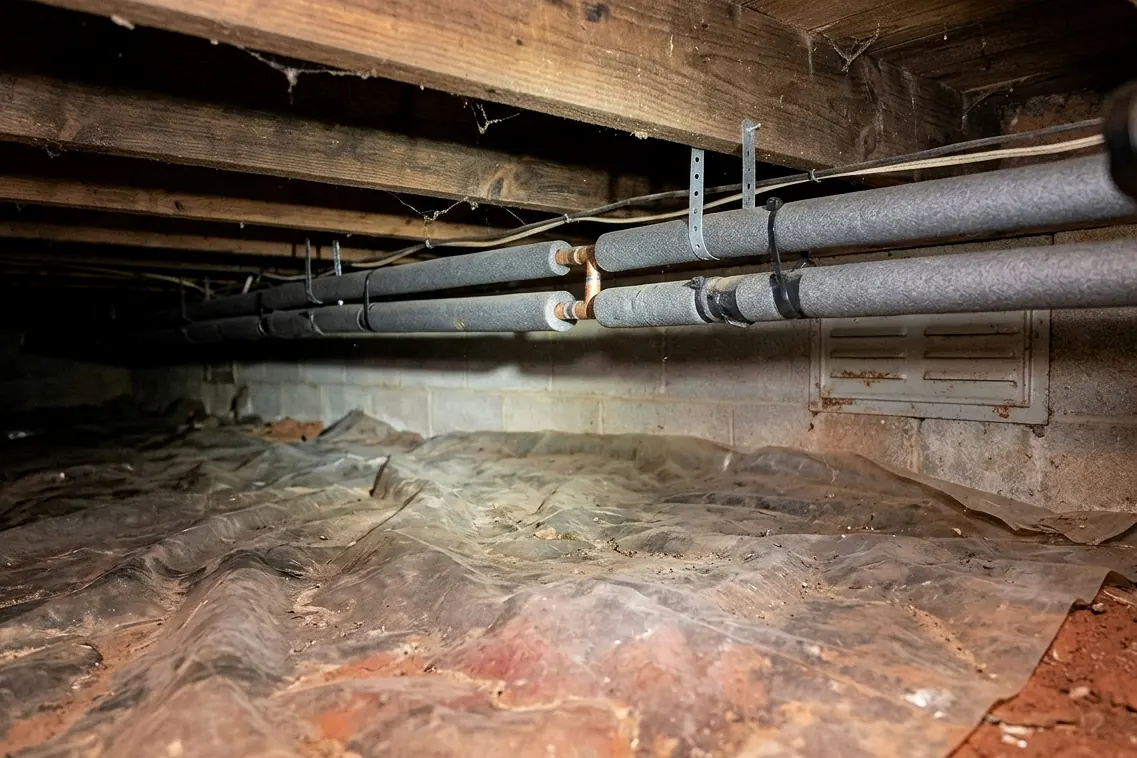
Foam pipe sleeves are the easiest insulation to add. They slip over the pipe and close with a seam, and they cost little per length. Pay special attention to bends, valves and fittings, which are the most likely places to freeze. Leave the main shut-off valve reachable, not buried under insulation, so you can still close it quickly if a line breaks.
- Close or cover foundation vents for the coldest part of winter
- Insulate exposed water lines with foam pipe sleeves, including bends and valves
- Seal gaps where pipes and wires pass through the foundation
- Make sure the crawl space access door closes and is not broken
- Disconnect garden hoses and close inside valves for outdoor faucets
On the coldest nights
When the forecast drops into the teens or lower, take a few extra steps. Let a faucet drip on an outside wall, using both hot and cold if the lines run under the floor. Moving water is much harder to freeze, and a drip also relieves pressure in the line if ice starts to form. Open cabinet doors under kitchen and bathroom sinks on outside walls so warm room air reaches the pipes.
Keep the thermostat at a normal temperature overnight, even if you usually turn it down. If you are traveling, leave the heat on and ask a neighbor to check the house. For homes that freeze often, a plumber can install heat cable on the lines that keep giving trouble. Do not use open flames, propane heaters or improvised heat lamps in a crawl space, since they are a fire risk around wood framing and insulation.
Longer-term fixes
If the same section of pipe freezes every few years, a lasting fix makes more sense than reacting each winter. The right answer depends on where the problem is, how the crawl space is built and how much of the pipe is exposed. Crawl space plumbing repair can reroute a line away from a vent or outside wall, add heat cable, or replace damaged sections at the same time.
Some Triangle owners choose to encapsulate the crawl space, sealing the vents and adding a vapor barrier, which keeps the space warmer in winter and drier in humid summers. That is a larger project, usually done by a crawl space contractor, and it changes how the space is ventilated, so it is worth getting advice before closing up vents permanently.
- Reroute lines away from vents and outside walls
- Add thermostatically controlled heat cable to trouble spots
- Replace old galvanized or polybutylene lines that split easily
- Consider encapsulation to keep the whole space warmer
If a pipe freezes anyway
A frozen line usually shows itself when you turn on a faucet and get a trickle or nothing at all. If that happens, keep the faucet open, find the frozen section if you can, and warm it gently with a hair dryer or warm towels, working from the faucet back toward the frozen spot. Never use a torch or open flame. If you cannot find it or reach it, call for frozen pipe repair.
Know where the main shut-off is before you start, because a frozen pipe may already be split. As ice melts, water can start spraying. Keep a flashlight, towels and a bucket nearby while you work. Once the line thaws and water flows again, check the whole length you can see for drips or spray. Our guide on what to do after a pipe bursts walks through the first steps if you find a split.
What to check after the freeze
Once temperatures rise, look in the crawl space for wet insulation, dripping joints or puddles, and check the water meter with every fixture off to see if it is still moving. A slow leak under the floor can go unnoticed for weeks and cause rot, mold and high bills. Serenity Plumbing works across Raleigh and the Triangle, and you can call (919) 557-9058 day or night if you find a leak or a line that will not thaw.
A typical crawl space freeze repair in the Raleigh area runs about $287 to $694 for an accessible break. Rerouting lines or adding heat cable usually costs more, depending on how much pipe is involved and how easy the space is to work in. The real price is given after a plumber has been in the crawl space and seen the lines, the insulation and the access.
Follow-up questions
Should crawl space vents stay closed all year?
Not usually, unless the crawl space has been encapsulated. Traditional vented crawl spaces rely on airflow to manage moisture in humid Triangle summers. Many owners close or cover vents during the coldest weeks of winter and open them again in spring. If you want them closed year-round, encapsulation with a vapor barrier is the better approach.
Can heat cable on crawl space pipes be a fire risk?
Heat cable is safe when it is listed for the job, installed according to the manufacturer's instructions and plugged into a proper outlet. Problems come from overlapping cable, wrapping it under the wrong insulation, or using old or damaged cable. Products with a built-in thermostat that turns on only near freezing are the most common choice.