Fixtures and bathrooms
Shower valve repair for drips, scalds and weak flow in Raleigh
Your shower drips after it is shut off, turns cold when someone runs the kitchen tap, or the handle has gone so stiff you need two hands to move it.
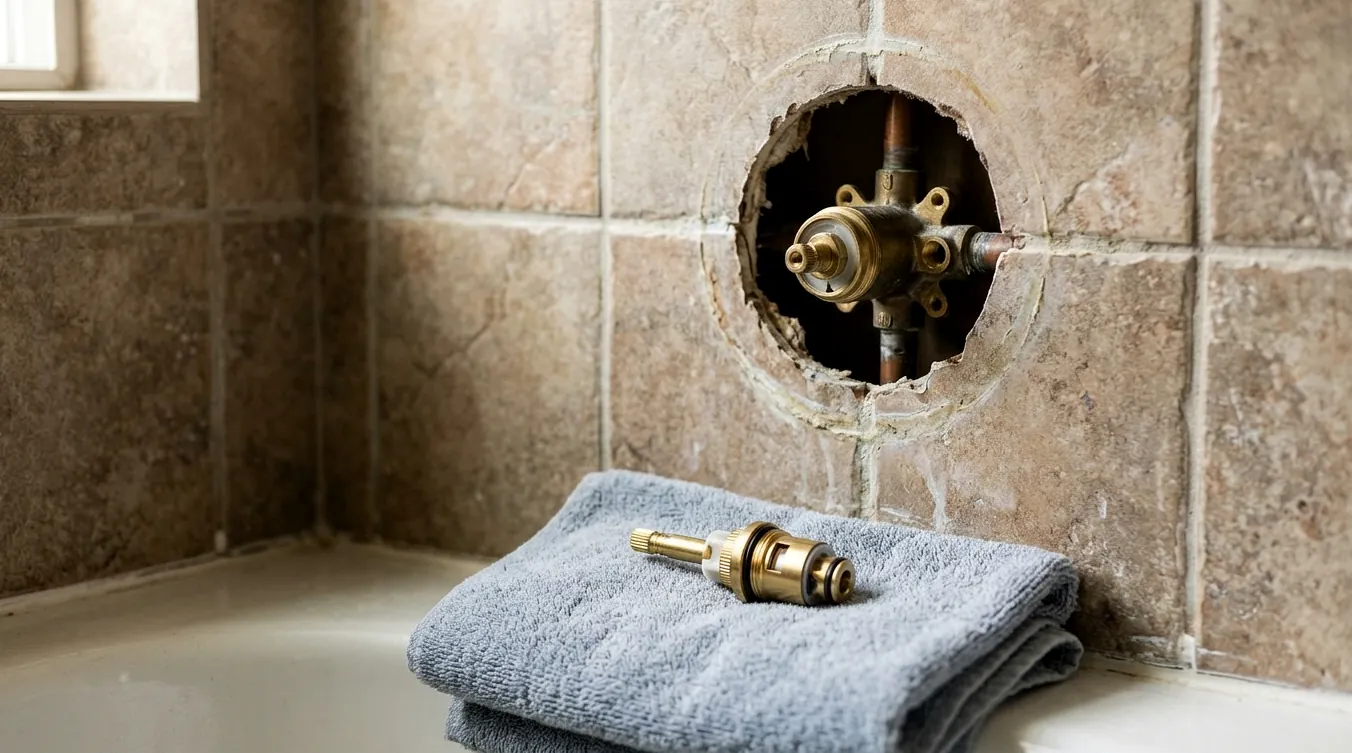
First step on arrival: shut off and open
Almost every shower problem that is not a clogged drain traces back to the valve hidden behind the trim plate. Inside it, a cartridge or a set of stems controls how much hot and cold water mixes and how much flows. Mineral deposits, worn O-rings and cracked seats make the valve drip, stick or lose its ability to hold a steady temperature. In most cases the valve body in the wall is fine, and only the parts inside need replacing.
Serenity Plumbing repairs shower valves across Raleigh and the Triangle with its own plumbers, on single-handle, two-handle and three-handle setups. We identify the brand from the trim and the cartridge, carry the common cartridges on the truck, and can source the less common ones quickly. When the body itself has failed, we work from an access panel where one exists.
When a shower valve needs attention
Drip after shutoff
A showerhead or tub spout that keeps dripping for more than a minute after closing points to a worn cartridge or seat washer.
Sudden temperature swings
Water that scalds or turns cold when a toilet flushes means the pressure balancing part of the cartridge is no longer reacting.
Stiff or loose handle
A handle that grinds, sticks or spins without changing anything usually has mineral buildup or a stripped cartridge stem.
Never gets hot
If the heater is fine but the shower never gets hot, the rotational limit stop may be set wrong or the cartridge is failing.
Weak flow at one fixture
Low pressure at the shower only, while the sinks run strong, often comes from debris lodged in the cartridge or a clogged inlet screen.
Stains below the trim
Water marks on the ceiling below or soft drywall behind the shower suggest a leak at the valve body or its connections.
How we repair and replace shower valves
We shut the water off at the valve's own stops if it has them, or at the main if it does not, then pull the handle and trim. The cartridge or stems tell us the brand and model, which matters because Moen, Delta, Kohler, Price Pfister and older Sterling valves each take different parts. We check the seats and body for scale and pitting while the valve is open.
Most visits end with a cartridge swap, new O-rings and silicone grease, and a properly set temperature limit. On two-handle and three-handle valves, we replace stems, seat washers and seats together so the repair holds. If you have an older two-handle valve with no pressure balancing, we explain the option of converting to a single-handle pressure balancing valve, which protects against sudden scalds when someone else in the house uses water.
Full valve replacement means opening the wall. When there is a closet or access panel behind the shower, we work from that side and leave the tile untouched. When there is not, we cut a neat opening and fit a larger trim plate that covers it. Every new valve gets a pressure test before the wall is closed, and we set the anti-scald limit so the hottest setting is comfortable rather than dangerous.
How the job goes
Shut off and open
We isolate the water, remove the handle and trim plate, and protect the tub or shower floor before any tools come out.
Identify the valve
We match the brand and cartridge so the replacement parts fit exactly, rather than forcing a universal part that starts leaking within a year.
Clean and inspect
Seats, ports and the valve body get cleaned of scale and checked for pitting or cracks that would ruin a new cartridge.
Replace worn parts
We install the new cartridge or stems, seats and O-rings, or a complete valve body when the old one cannot be saved.
Set temperature limit
We adjust the rotational limit stop, run hot and cold through the full range, and check for drips at the head and spout.
Shower valves in Triangle homes
Homes built across Raleigh, Cary and Garner from the late 1970s into the 1990s often have single-handle valves fed by gray polybutylene supply lines, which were common in that era. When we open one of those walls, we check the PB connections closely, since a failed fitting behind a shower can soak the subfloor for weeks before anyone notices. If we find polybutylene, we will tell you and talk about replacing those lines.
Older homes in Hayes Barton, Mordecai and Boylan Heights frequently still have two-handle or three-handle tile-in valves, sometimes with galvanized pipe behind them. Those can usually be rebuilt, though parts for discontinued brands take some hunting, and the galvanized pipe feeding them is often worth replacing. In newer homes in Holly Springs and Apex, the common call is a builder-grade cartridge that started dripping or sticking.
Typical shower valve repair costs
| Job | Typical range |
|---|---|
| Cartridge replacement, common brands | $187 to $338 |
| Two-handle stem and seat rebuild | $214 to $387 |
| Full valve body replacement from access panel | $593 to $947 |
| Pressure balancing valve conversion | $687 to $1,236 |
| Valve replacement with tile opening and larger trim | $812 to $1,386 |
The valve brand, whether there is an access panel, the pipe material behind the wall and any tile work move the price most. A plumber gives you the actual number after opening the trim. See every range in our plumbing cost guide.
Questions about shower valve repair
Why does my shower drip even when the handle is fully off?
Water is getting past a worn seal inside the valve. On single-handle valves that is usually the cartridge or its O-rings; on two-handle valves it is a seat washer or the seat itself. Mineral scale keeps the seal from closing evenly, and a slow drip tends to get faster over time.
Do I have to tear out tile to replace a shower valve?
Not usually. Most cartridge and stem repairs happen through the front with only the trim removed. For a full valve body swap, we first look for an access panel in the closet or hallway behind the shower. If there is no access, we make the smallest opening we can and use an oversized trim plate to cover it, so retiling is rarely needed.
What is a pressure balancing valve and do I need one?
It is a shower valve with a part inside that reacts when hot or cold pressure drops, so a flushing toilet does not send a burst of scalding water. Code calls for this protection on new shower valves. If your older valve lacks it, converting is worth considering, especially in homes with young children or older adults.
Is a shower that won't shut off an emergency?
If water keeps running and the handle will not stop it, close the shutoffs behind the access panel if you have them, or the main valve for the house. Then give us a call at (919) 557-9058; we answer around the clock. A stuck valve can run up a water bill quickly and, on a tub with a slow drain, overflow onto the floor.
Related
Related plumbing services
Faucet Repair & Installation
The kitchen faucet drips all night, the handle is stiff, or the new faucet you bought has been sitting in its box for...
Learn moreBathroom Remodel Plumbing
Your bathroom is gutted or about to be, and you need the drains, vents and supply lines moved and roughed in before the...
Learn moreLeak Detection
Your water bill jumped, the meter keeps spinning with everything off, or a patch of floor feels damp, but there is no...
Learn moreWater Heater Repair
The shower ran cold this morning, the tank is making popping noises, or there is a puddle forming around the base of...
Learn morePlumbing problem right now?
Call and a person answers, day or night. A plumber from our downtown Raleigh office comes to you.