Emergency and leaks
Finding hidden leaks in Raleigh homes without guesswork
Your water bill jumped, the meter keeps spinning with everything off, or a patch of floor feels damp, but there is no puddle and no obvious source.
First step on arrival: meter and valve test
A hidden leak is frustrating because the evidence is indirect. The meter tells you water is going somewhere, a stain tells you roughly where it ended up, but neither tells you which pipe failed. Serenity Plumbing uses listening equipment, thermal imaging, moisture meters and isolation tests to narrow the source to a small area, so the opening we make is a small, planned one instead of a row of exploratory holes in your drywall.
Leak detection pays off before a problem becomes a repair bill somewhere else. A slow drip inside a wall can rot framing and feed mold for months before it shows. If the leak turns out to be under the foundation, we explain your slab leak repair options, and if it is in the yard, the fix moves to the service line.
Clues that point to a leak you cannot see
Meter moving, taps off
With every fixture and appliance off, the small leak indicator on your water meter still turns, which means water is escaping somewhere.
Bill higher than usual
A water and sewer bill that climbs month after month without a change in household use is often the first sign of a hidden leak.
Sound of running water
You hear a faint hiss or trickle in a wall or under the floor late at night when nothing in the house is running.
Warm spot on the floor
A section of tile or hardwood that feels warm underfoot often means a hot water line is leaking in the slab beneath it.
Musty smell in one room
A persistent damp or musty odor in a closet or cabinet, with no spill to explain it, can come from a slow joint leak.
Low pressure at fixtures
Pressure that has quietly dropped at several fixtures can mean water is escaping from the supply side before it reaches them.
How we narrow a leak down to one spot
The first test is simple. With all water use stopped, the plumber watches the meter and then closes the main valve. If the meter stops, the leak is inside the house. If it keeps moving, the problem is in the service line between the meter and the house. That single check decides whether we spend the next hour in your walls or in your yard.
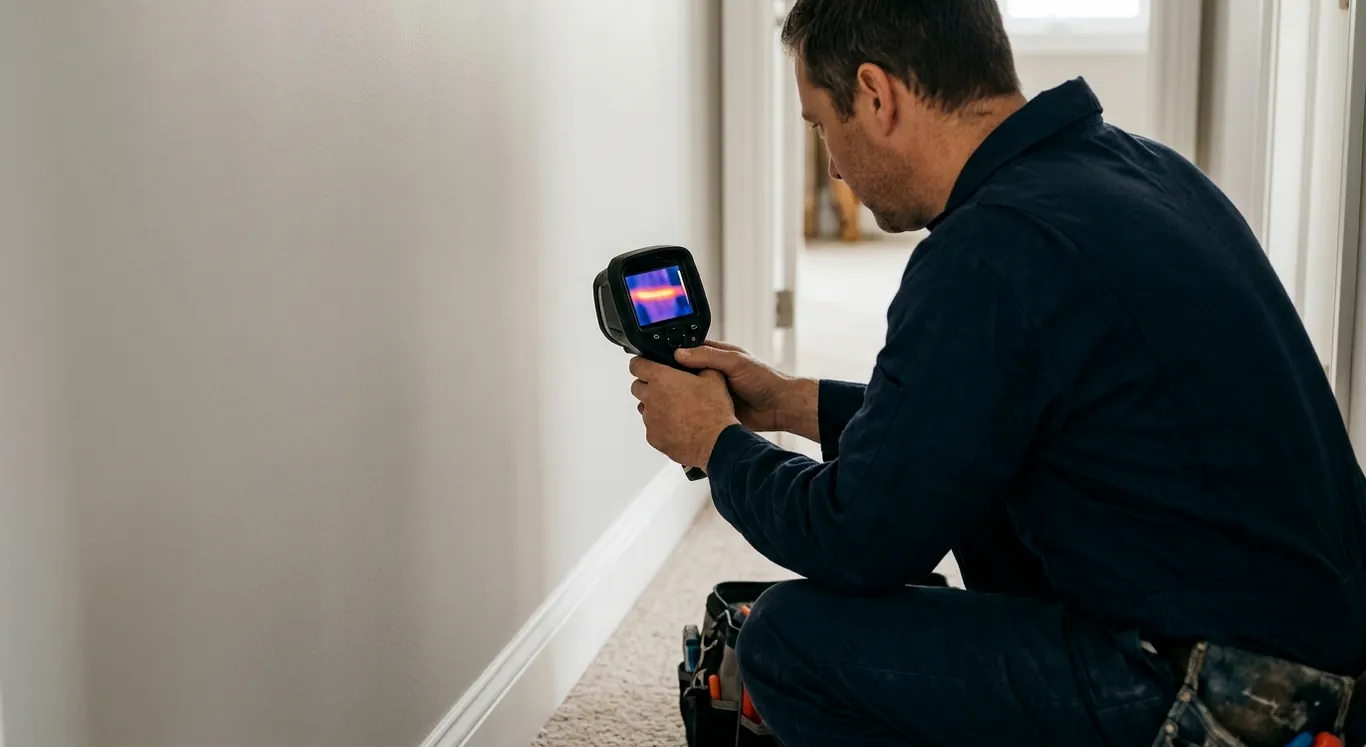
Inside the house, we isolate the hot and cold sides, then individual branches where valves allow it. A pressure gauge on a hose bib shows how fast a closed system loses pressure. Thermal imaging picks up the temperature trail of a hot line leak through drywall or tile, and an acoustic listening device hears water escaping under pressure through concrete or flooring. Each tool covers a weakness in the others.

Once the leak is pinpointed, the plumber marks the spot, shows you the readings and explains what opening the area will involve. Many leaks are repaired the same visit: a pinhole in copper, a failed polybutylene fitting, a loose drain slip joint. If the leak is somewhere awkward, like inside a shower wall or under a slab, you get the options and prices before anything is cut.
How the job goes
Meter and valve test
We stop all water use, watch the meter and close the main valve to tell whether the leak is inside the house or in the yard.
Isolate the system
Hot and cold sides, and individual branches where valves exist, are tested separately with a gauge to shrink the search area.
Scan and listen
Thermal imaging, moisture readings and acoustic equipment trace the leak through walls, floors or concrete without opening anything yet.
Mark and explain
The plumber marks the leak location, shows you what the readings found and gives you the repair options with a price for each.
Repair and retest
After the repair, the system is pressurized and the meter is watched again to confirm the leak is gone and nothing else is losing water.
Where leaks hide in Triangle houses
Hidden leaks in the Triangle tend to follow construction style. Homes on crawl spaces, which covers much of older Raleigh and a good share of newer houses, often leak where pipes pass through floor framing or at fittings that sag between hangers. Homes on slabs, which show up in many townhome communities and subdivisions across Wake County, hide their supply lines in concrete, and those leaks take more careful listening.
Material matters too. Gray polybutylene pipe from the late 1970s to mid 1990s fails at its fittings, copper in some homes develops pinholes over decades, and galvanized steel in older houses rusts from the inside. City of Raleigh Public Utilities and the Town of Cary both bill on metered use, so a slow leak usually shows up on the bill before it shows up on a wall. A high usage notice from your utility is a good reason to call.
Typical leak detection pricing
| Job | Typical range |
|---|---|
| Meter and pressure test, inside or outside | $127 to $238 |
| Full electronic leak detection, one level | $287 to $544 |
| Slab leak location with acoustic equipment | $364 to $689 |
| Repair of an accessible pinhole or fitting | $193 to $437 |
Price depends on how many lines need testing, whether the home is on a slab or a crawl space, and how much finished surface sits over the suspected area. See every range in our plumbing cost guide.
Questions about leak detection
How can I check for a leak myself before calling?
Turn off every faucet, appliance and irrigation zone, then look at the water meter. If it moves while nothing is on, water is leaking somewhere. Next, close the main shut-off inside the house. If the meter stops, the leak is indoors. If it keeps turning, the service line outside is the likely cause.
Will you have to tear open my walls to find the leak?
Not to find it. The testing is done from the outside of walls and floors with gauges, thermal cameras and listening equipment. Once the leak is located, a small opening is usually needed to make the repair, and we keep it as tight to the leak as possible.
Can a leak stay hidden for months without any visible damage?
Yes. A slow drip inside a wall cavity or into a crawl space can soak into framing and insulation for a long time before a stain appears. That is why a rising bill or a moving meter is worth taking seriously even without a wet spot.
Does homeowners insurance pay for finding a hidden leak?
Policies differ, so check yours. Many cover sudden water damage and sometimes the cost of locating the leak, while the pipe repair itself may or may not be included. Gradual leaks are often treated differently from sudden ones. We give you a written description of what we found and what we repaired, which is the kind of record an adjuster usually asks for.
Related
Related plumbing services
Slab Leak Repair
A warm spot on the floor, water seeping at a baseboard or a meter that never stops points to a pipe leaking under your...
Learn moreWater Line Repair
There is a soft, wet patch in the yard that never dries out, or your water bill jumped and nothing inside the house is...
Learn morePolybutylene Pipe Replacement
You found gray plastic pipe stamped PB2110 in the crawl space or behind the water heater, and you want to know how long...
Learn moreWhole-House Repiping
Leaks keep popping up in different places, the water runs rusty or weak, or an inspector flagged the old supply pipes...
Learn morePlumbing problem right now?
Call and a person answers, day or night. A plumber from our downtown Raleigh office comes to you.