Water heaters
Diagnosing error codes and cold bursts on Raleigh tankless units
Your tankless heater is flashing an error code, shutting off mid-shower, or sending bursts of cold water between hot, and resetting it has not helped.
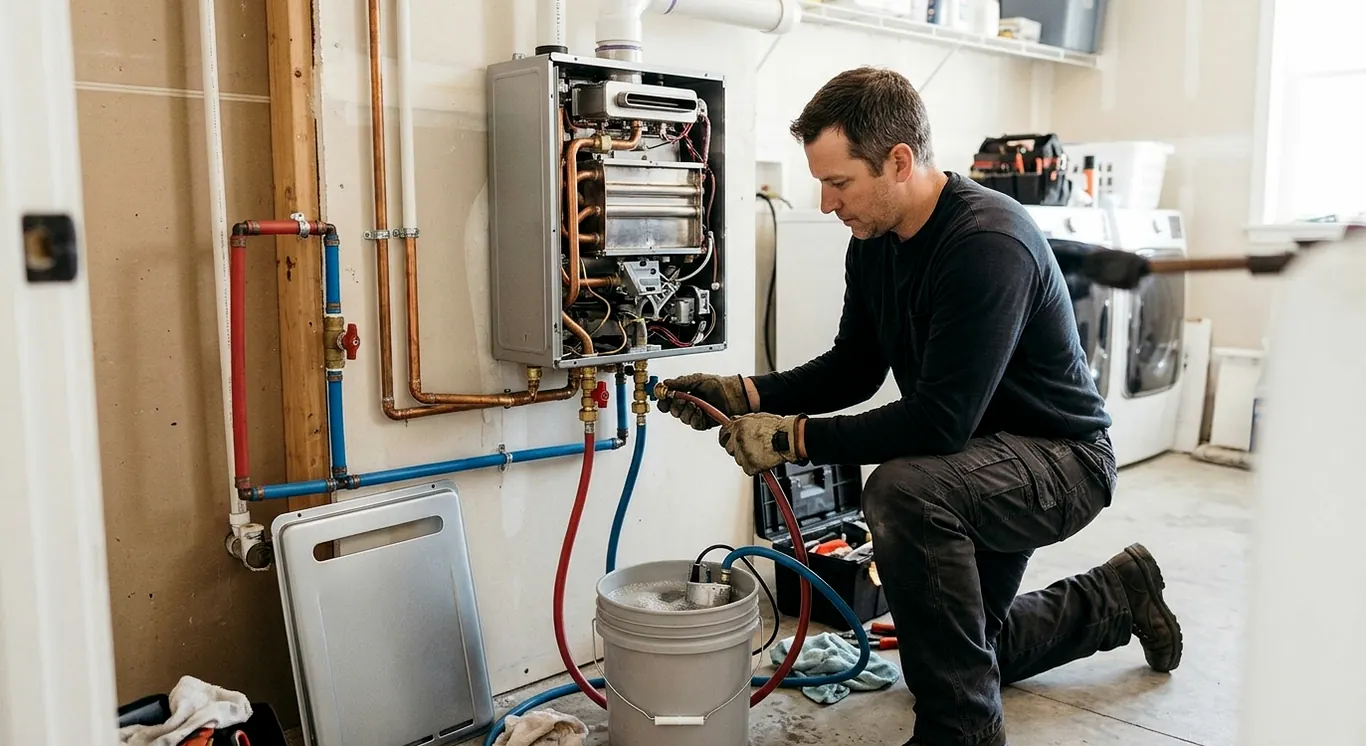
First step on arrival: read the history
Tankless heaters fail differently from tanks. Instead of a single burned element or a leaking shell, they report faults through codes tied to ignition, flame, airflow, water flow or overheating. Many of those codes trace back to a few causes: scale on the heat exchanger, a clogged inlet filter, a blocked vent or condensate line, or a gas supply that drops when other appliances run. Each one has a different fix, so reading the code is the starting point, not the answer.
Serenity Plumbing services gas and electric tankless units from the common brands sold around the Triangle. We read the fault history, test sensors and flow, and check the installation itself, since a fair share of repeat problems come from undersized gas lines or vent runs that were never right. If the unit was sized poorly from the start, we will say so and explain what a corrected tankless installation would involve.
Signs your tankless heater needs service
Error code on display
The control panel shows a fault number, and the heater locks out or restarts only after a power cycle.
Cold water sandwich
Hot water turns briefly cold and then hot again, especially after a short pause between uses at the same tap.
Shuts off at low flow
The heater cuts out when a faucet is opened only partway, often from a dirty inlet filter or failing flow sensor.
Temperature swings
Water drifts from hot to lukewarm during a shower, which can point to scale, low gas pressure or an overloaded unit.
Clicking, no ignition
You hear the igniter click repeatedly but the burner never lights, so no hot water reaches the fixtures.
Water under the unit
Drips below the heater can come from a failed relief valve, a loose fitting, or a clogged condensate line backing up.
How Serenity repairs tankless water heaters
We start with the unit's fault history, which many models store along with the current code. Then we measure what the heater is seeing: gas pressure at the inlet with other gas appliances running, water flow rate, and inlet and outlet temperatures. A unit that throws ignition faults only when the furnace and range are on usually has a gas supply problem, not a broken part. That distinction saves you from buying parts that will not fix anything.
Scale is the most common cause of overheating codes and temperature swings, especially on well water. We isolate the unit with its service valves, circulate a descaling solution through the heat exchanger, flush it clean, and clean the inlet filter screen. If service valves were never installed, we add them so future descaling is simple. Condensing units also get their condensate trap and line cleared, since a blocked line can shut the heater down.
When a part has failed, we replace it: flame rods, igniters, flow sensors, thermistors, fans and gas valves are typical. We also check vent terminations for nests or debris and confirm vent joints are sealed. Every repair ends with a full fire test at several fixtures. If you have no hot water at night, call (919) 557-9058; our plumbers answer 24/7.
How the job goes
Read the history
We pull current and stored fault codes, then ask when the problem happens, since timing often points straight at the cause.
Measure supply
Gas pressure, water flow and electrical supply are measured under real conditions, with other appliances running where it matters.
Descale and clean
We flush the heat exchanger, clean the inlet filter, and clear the condensate trap and line when scale or blockage is found.
Replace failed parts
Sensors, igniters, fans or valves that test bad are replaced with matching parts, then connections are leak checked.
Fire test
We run hot water at low and high flow from several fixtures to confirm stable temperature and no further codes.
Why tankless units act up in Triangle homes
Water quality varies across the area. Homes on municipal systems such as Raleigh, Cary or Durham tend to scale slowly, but scale still builds over a few years without descaling. Homes on private wells in places like Johnston County and rural Franklin County often have harder water and iron, which coat heat exchangers faster and clog inlet screens. If you are on a well, more frequent descaling or a softener can prevent repeat overheating codes.
Weather plays a part too. Outdoor units and units vented through exterior walls can be hit by hard freezes, and a power outage during a cold snap can leave freeze protection off. Summer storms and hurricane remnants sometimes blow debris into vent terminations or flood low condensate drains. Wasps and birds also like to build in outdoor vent caps, which can cause airflow faults that look like a part failure.
Tankless repair costs around Raleigh
| Job | Typical range |
|---|---|
| Diagnostic visit with gas and flow testing | $128 to $247 |
| Descale and flush heat exchanger | $187 to $364 |
| Install service isolation valves | $213 to $418 |
| Replace igniter or flame rod | $238 to $463 |
| Replace flow sensor or thermistor | $264 to $537 |
| Replace fan motor or gas valve | $417 to $893 |
Brand, part availability, and whether the problem is the unit or the gas, vent or water supply feeding it all affect the price. We confirm the actual cost after testing. See every range in our plumbing cost guide.
Questions about tankless water heater repair
What causes the burst of cold water in the middle of my hot shower?
That cold sandwich happens when you turn the water off and back on quickly. Hot water left in the pipe comes out first, then the heater needs a few seconds to fire again, so a slug of unheated water passes through. It is normal to a degree. If it is severe, a small buffer tank or a recirculation setup can smooth it out.
How often should I have my tankless heater descaled?
On city water in Raleigh, Cary or Durham, many homes are fine with a descale every year or two. On private well water with more minerals, once a year or more often may be needed. Rising outlet temperature swings or overheating codes are signs it is overdue. A softener on well water extends the time between descales.
My tankless heater works fine until the furnace turns on. Why?
That usually means the gas line cannot supply both appliances at full demand. When the furnace fires, gas pressure at the tankless unit drops below what it needs, and it throws an ignition or flame code. The fix is often a larger gas line or a dedicated run, not a new heater. We confirm it with a pressure test under load.
Is my tankless heater worth fixing or should I replace it?
Most tankless units are built to be serviced, and parts like igniters, sensors and fans can be replaced many times. A cracked or badly scaled heat exchanger on an older unit is the main reason to consider replacement. We test the exchanger and tell you whether a repair makes sense based on the unit's age and condition.
Related
Related plumbing services
Tankless Water Heater Installation
You want endless hot water and a freed-up closet or garage corner, but you are not sure your gas line, venting and...
Learn moreWater Heater Repair
The shower ran cold this morning, the tank is making popping noises, or there is a puddle forming around the base of...
Learn moreGas Line Repair
You noticed a rotten egg odor near the water heater or the yard, the utility shut off the meter, and now the house has...
Learn moreWater Softener Installation
White crust is building on your faucets and shower glass, soap will not lather well, and your water heater is getting...
Learn morePlumbing problem right now?
Call and a person answers, day or night. A plumber from our downtown Raleigh office comes to you.