Emergency and leaks
Pressure reducing valve replacement for Raleigh water systems
Faucets bang shut, the toilet fill valve hisses, the water heater relief valve keeps dripping, and a gauge on the hose bib reads well above 80 psi.
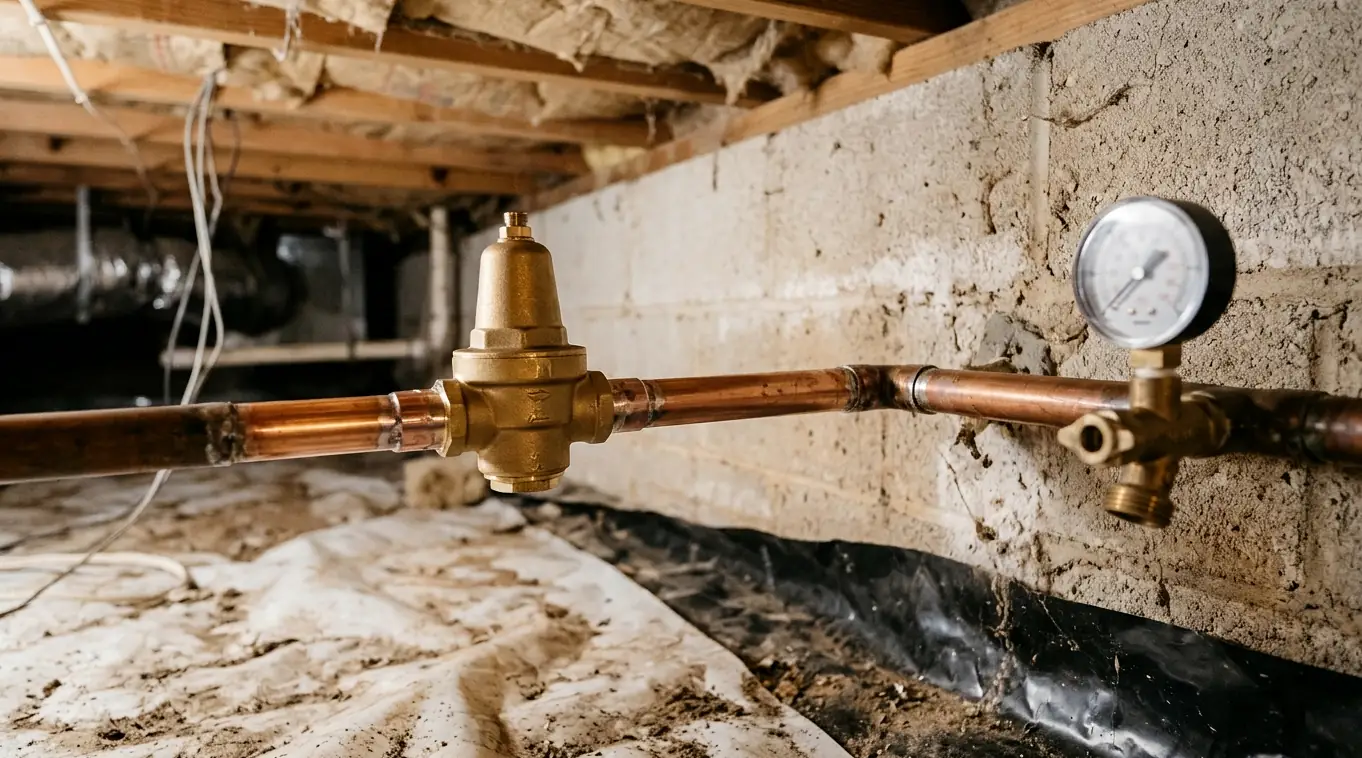
First step on arrival: test house pressure
A pressure reducing valve, or PRV, sits on the main water line where it enters the house and lowers street pressure to a level your plumbing can live with. When it fails, pressure creeps up and every fixture, hose and appliance connection in the house takes the strain. Serenity Plumbing tests your pressure, confirms whether the valve is the cause and replaces it with a properly sized unit, set and checked with a gauge before we leave.
Plumbing code calls for a PRV when incoming pressure is above 80 psi, and most homes do best somewhere in the 40 to 80 psi range. Too high and you get leaks, worn washers and early appliance failures. Too low and showers feel weak. Our article on signs of high water pressure lists the symptoms homeowners notice first, from noisy pipes to short-lived supply hoses.
Symptoms of a failing pressure reducing valve
Banging when taps close
Loud knocking in the walls when a faucet, washer or dishwasher valve shuts off is water hammer, and high pressure makes it worse.
Relief valve dripping
A water heater T&P valve that drips or discharges often is reacting to pressure spikes that a working PRV would normally prevent.
Pressure that keeps changing
Strong flow in the morning, weak flow in the evening, or pressure that drifts day to day points to a PRV that is wearing out.
Toilets running on their own
Fill valves that hiss or toilets that refill without being flushed can be forced open by pressure above what they were built for.
Gauge reads over 80 psi
A hose bib gauge showing more than 80 psi means the valve is not reducing pressure enough and should be adjusted or replaced.
Sudden drop to a trickle
PRVs can also fail closed, leaving the whole house with weak flow even though the street supply is normal.
How we test and replace a PRV
The plumber starts with a pressure gauge on an outside hose bib or the laundry connection, reading both static pressure and how it behaves when fixtures open and close. If pressure is high or unstable, the next step is finding the PRV, which in Raleigh homes is usually near the main shut-off, in the crawl space by the foundation wall, or in a box near the meter.
Some valves can be adjusted or rebuilt, and if yours is in good shape, that is what we do. Most failed PRVs are simply replaced, since a new valve costs little more than a full rebuild. The plumber closes the main, cuts out the old valve and installs a new one sized to the line. If the main shut-off next to it is old or seized, replacing it in the same visit saves a second trip and a second shutdown.
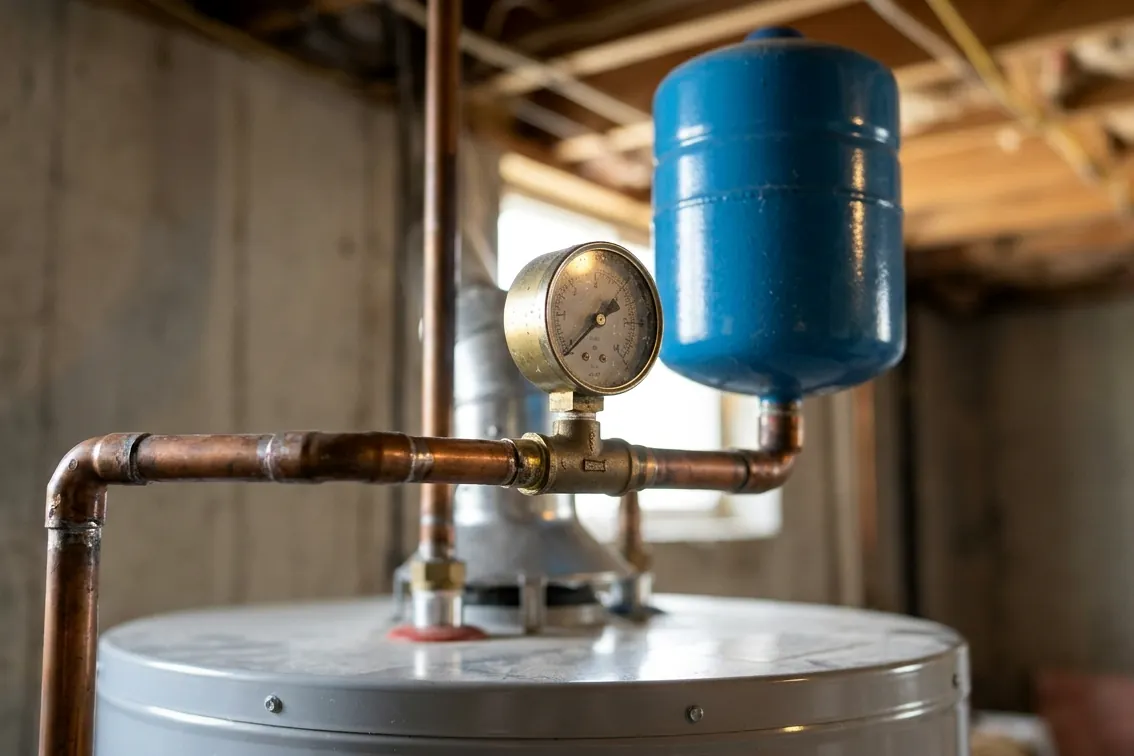
With a PRV in place, the plumbing becomes a closed system, and water expanding in the heater has nowhere to go. The plumber checks whether a thermal expansion tank is installed and sized right, and adds or replaces one if needed, charged to the right air pressure for your house. Then the new PRV is set to the target pressure, the system is run through several fixture cycles.
How the job goes
Test house pressure
A gauge on a hose bib records static pressure and overnight spikes, showing whether the PRV is failing, missing or set wrong.
Locate the valve
We find the PRV near the main shut-off, in the crawl space or by the meter and check its condition and size.
Replace or rebuild
A worn valve is rebuilt when practical or replaced with a new unit sized to the line, installed with unions for easy service.
Check expansion control
The water heater's thermal expansion tank is checked and added or replaced so pressure does not build when the heater runs.
Set and verify
The new valve is set to a target between 40 and 80 psi, tested through fixture cycles and the reading is recorded for you.
Water pressure across Raleigh and the Triangle
Street pressure varies a lot around the Triangle, depending on elevation and distance from water towers and pump stations. Homes on low ground or near a pressure zone boundary can see incoming pressure well above what a house needs, which is why many Raleigh and Cary homes have PRVs in the first place. In newer subdivisions in Holly Springs and Wake Forest, a PRV is often standard on the service line.
PRVs wear out like any valve, and the ones installed in homes built twenty or more years ago are often near the end, with worn seats and tired springs. If City of Raleigh Public Utilities or the Town of Cary has recently done water main work on your street and your pressure changed afterward, the valve is worth checking. Homes on private wells do not use a PRV, since the pressure switch controls the system.
Pressure reducing valve costs in Raleigh
| Job | Typical range |
|---|---|
| Water pressure test and diagnosis | $97 to $186 |
| PRV adjustment or rebuild | $164 to $318 |
| PRV replacement, 3/4 inch line | $412 to $788 |
| PRV replacement, 1 inch line | $487 to $914 |
| Thermal expansion tank installed | $237 to $468 |
Line size, valve location and whether the main shut-off or expansion tank also needs work affect the total. A PRV in a tight crawl space or meter box takes longer to reach. See every range in our plumbing cost guide.
Questions about pressure reducing valve replacement
How do I check my own water pressure at home?
Buy an inexpensive pressure gauge that threads onto a garden hose fitting. Screw it onto an outdoor faucet or the washing machine cold connection, make sure no water is running inside, and open the faucet fully. The reading is your static pressure. If it is over 80 psi, or if a gauge with a red maximum needle shows spikes overnight, the PRV should be looked at.
Why is my water heater relief valve dripping after a new PRV?
A working PRV closes the system, so when the water heater warms up, the expanding water has nowhere to go and pressure climbs until the T&P valve opens. The fix is a thermal expansion tank on the cold line near the heater. If you already have one, it may have lost its air charge or failed, which our plumber can test on site.
How long does a pressure reducing valve usually last?
Many last ten to fifteen years, sometimes longer, but water quality and debris shorten that. A valve that is drifting, chattering or letting pressure creep up is wearing out regardless of age. Testing pressure every few years is a good habit in an older home.
Can high water pressure shorten the life of my appliances?
Yes. Dishwashers, washing machines, ice makers, toilet fill valves and water heaters all have valves and hoses rated for a pressure range. Living above 80 psi wears seals faster, makes supply hoses more likely to burst. Bringing pressure down to the normal range is one of the less expensive ways to protect them.
Related
Related plumbing services
Main Shut-Off Valve Replacement
A pipe is leaking and the main water valve will not turn, only turns partway, or drips from the stem every time you...
Learn moreWater Heater Repair
The shower ran cold this morning, the tank is making popping noises, or there is a puddle forming around the base of...
Learn moreBurst Pipe Repair
A pipe has split, water is spraying or pouring into the house, and you need it stopped and repaired before the floors...
Learn moreLeak Detection
Your water bill jumped, the meter keeps spinning with everything off, or a patch of floor feels damp, but there is no...
Learn morePlumbing problem right now?
Call and a person answers, day or night. A plumber from our downtown Raleigh office comes to you.