Pipes, water and gas lines
New water service lines from the meter to your Raleigh home
The water line to your house has leaked more than once, the pressure keeps fading, or the water comes out tinted after the tap sits overnight.
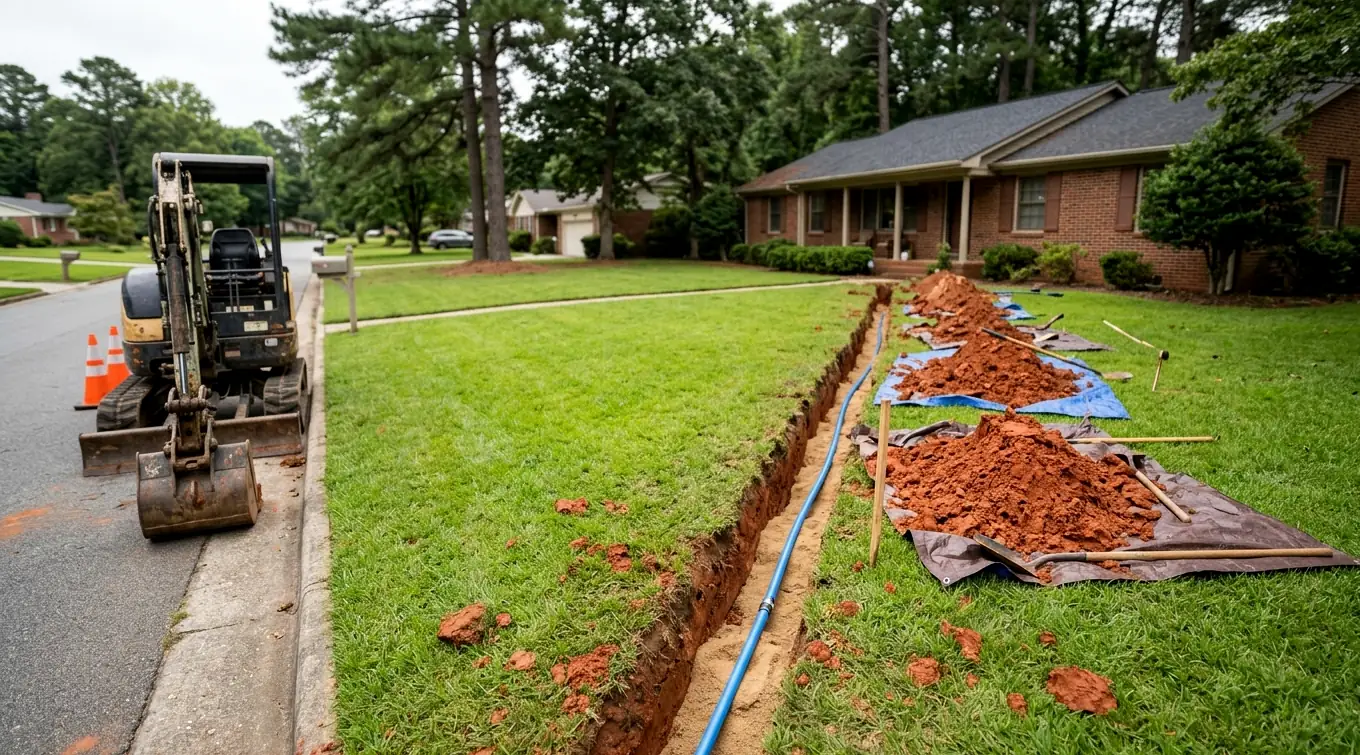
First step on arrival: survey the route
Patching a buried line makes sense once. When it keeps failing, or when the pipe itself is the wrong material, a new line from the meter to the house is usually the better use of money. Old galvanized steel rusts shut from the inside. Early plastic and polybutylene service lines crack with age. Some homes were also built with a line too small for the bathrooms and irrigation they have today.
Serenity Plumbing replaces the full service line, from the meter connection to the main valve inside the house. Depending on the yard, we dig a narrow trench or pull new pipe underground with boring equipment to save the lawn and driveway. Either way, you get one continuous run with no buried joints. Give us a call at (919) 557-9058 to have a plumber look at your line and talk through options.
Signs it is time for a new service line
Repeated leaks on one line
Repeated breaks on the same line mean the pipe is failing as a whole, and the next repair will not be the last.
Rusty or brown water
Discolored water at every tap, worst first thing in the morning, often points to a corroded galvanized line.
Weak pressure everywhere
Galvanized pipe narrows inside as rust builds up, so flow at every fixture drops even when the city pressure is normal.
Gray or thin plastic line
Polybutylene and early thin wall plastic service lines are near the end of their useful life in many Triangle homes.
Bigger house, same pipe
Added bathrooms, an irrigation system or a larger family can outgrow an older half inch or three quarter inch line.
Planned driveway or patio
Replacing an old line before new concrete goes down saves you from breaking that concrete later to reach it.
How Serenity replaces a water service line
First we find the current route and the meter location, then decide between trenching and boring. A narrow trench works well across open lawn and lets us lay the pipe on a bed of sand. Under driveways, sidewalks and mature trees, we often bore or pull the new line through so we only open pits at each end. We mark utilities through NC 811 before any digging starts.
For the pipe itself, we usually run PEX or polyethylene water service tubing rated for burial, sized for your home's actual demand. Many older homes get bumped from three quarter inch to one inch, which helps when two showers and the irrigation run at once. At the house, the new line comes through the foundation with a sleeve and connects to a new main valve, and we add a pressure reducing valve when pressure runs above 80 psi.
We coordinate with the utility when the meter connection needs work, and we keep the water off for as short a window as possible, often just a few hours on the tie-in day. After the line is connected, we flush it, test it under pressure, and check the meter for movement. Then we backfill in layers and restore the surface, leaving a slight crown in the clay that settles flat.
How the job goes
Survey the route
We find the meter, the house entry point and anything in the way, such as trees, driveways, walkways and irrigation lines.
Choose trench or bore
You see both options with prices side by side, including how much of the lawn, beds or concrete each one disturbs.
Install the new line
One continuous length of pipe goes in at the right depth, sized for your fixtures, irrigation and any planned additions.
Connect and test
We tie in at the meter and the house, add a new main valve, then flush and pressure test the line.
Restore the yard
The trench or pits are backfilled and tamped in layers, and sod, mulch or gravel is put back in place.
Service lines in older and newer Raleigh neighborhoods
In older parts of Raleigh like Five Points and Oakwood, we still find galvanized steel service lines and short runs of old copper joined with mixed fittings. Those streets also have large shade trees with roots crossing the line path, so boring under the root zone is often the kinder choice for the tree. Front yards are often small and sloped, which shapes how we plan the pits.
In the suburbs built in the 1980s and early 1990s, the problem is more often a gray polybutylene or thin plastic line that has started to crack. Newer homes in Wake Forest and Fuquay-Varina usually have good pipe but may have a long run from a meter far out at the street. In rural parts of Johnston and Franklin counties, the line may run from a well instead of a meter, which changes the plan.
What a new water line costs
| Job | Typical range |
|---|---|
| Short run, open trench across lawn | $1,786 to $3,214 |
| Average run with trenchless boring | $2,937 to $5,468 |
| Long run or boring under a driveway | $4,615 to $8,290 |
| New main valve and foundation sleeve | $264 to $587 |
| Pressure reducing valve, if needed | $437 to $892 |
Length, depth, pipe size and what we must go under or around set the price. A plumber walks the route and gives you a firm figure before work begins. See every range in our plumbing cost guide.
Questions about water line replacement
How do I know if my service line is galvanized or plastic?
Look where the line enters the house near the main valve, usually in the crawl space or garage. Galvanized steel is dull gray metal with threaded joints, and a magnet will stick to it. Copper is reddish brown. Blue or black plastic is polyethylene, and gray plastic stamped PB is polybutylene. If you cannot reach it, we can check it during a visit.
Will boring the new line save my front lawn?
In most yards, yes. Boring needs a pit near the meter and another near the house, and the pipe travels underground between them. The lawn in the middle stays mostly untouched. It costs a bit more than a simple trench across open grass, but it often costs less once you count saving a driveway, walkway or the roots of a large tree.
Should I go up to a one inch line when I replace it?
If you have more than two bathrooms, an irrigation system, or plan to add either, a one inch line usually makes a clear difference in flow when several things run at once. The meter size matters too, so we check it before recommending a change. For a smaller house with no irrigation, three quarter inch is often enough.
How long will the house be without water on replacement day?
Most of the work happens while your old line is still in service. The water is only off during the final tie-in at the meter and the house, which usually takes a few hours. We tell you the window ahead of time so you can fill a few pitchers, plan showers, and avoid running the dishwasher or washer during that stretch.
Related
Related plumbing services
Water Line Repair
There is a soft, wet patch in the yard that never dries out, or your water bill jumped and nothing inside the house is...
Learn moreWhole-House Repiping
Leaks keep popping up in different places, the water runs rusty or weak, or an inspector flagged the old supply pipes...
Learn morePressure Reducing Valve Replacement
Faucets bang shut, the toilet fill valve hisses, the water heater relief valve keeps dripping, and a gauge on the hose...
Learn moreTrenchless Sewer Repair
The camera found a cracked or root-filled sewer line, but it runs under a driveway, a big oak or a finished patio you...
Learn morePlumbing problem right now?
Call and a person answers, day or night. A plumber from our downtown Raleigh office comes to you.