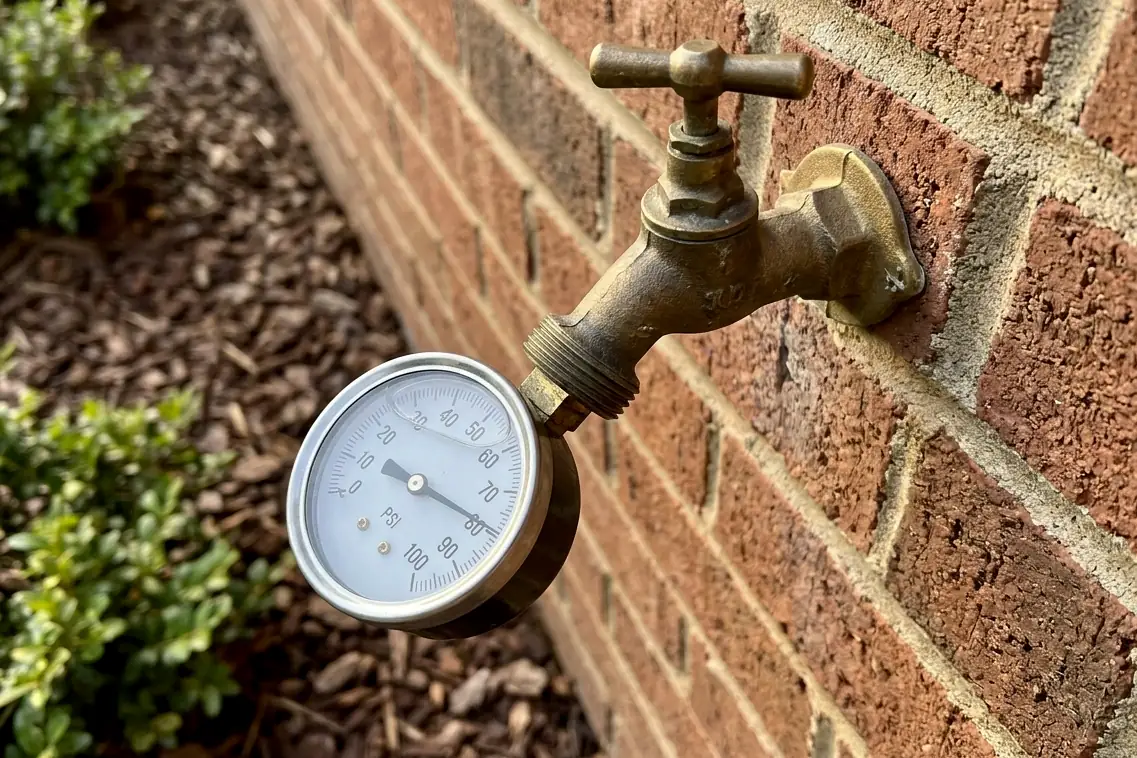
Test it with an inexpensive gauge on an outdoor faucet. Most homes should sit between 40 and 80 psi, and plumbing code calls for a pressure reducing valve when street pressure runs above 80 psi. Banging pipes and running toilets are common clues.
Why pressure varies across the Triangle
Water pressure at your house depends on how far you are from the utility's pumps and tanks, and on elevation. Homes in low spots or close to a pump station can see pressure well above what household plumbing is built to handle. Pressure can also change during the day as demand rises and falls, so a reading at noon may be lower than one at two in the morning when almost nobody is using water.
Many homes in Raleigh and nearby towns, newer subdivisions especially, have a pressure reducing valve, or PRV, on the main line to keep pressure in a safe range. A PRV is a spring-loaded valve that wears out, typically after 10 to 15 years. When it fails, pressure in the house climbs to match the street, and the first sign is often a toilet that keeps refilling or a faucet that drips no matter how hard you turn it.
Signs the pressure is too high
High pressure rarely causes one dramatic failure. It wears on everything in the system at once, which is why the clues show up in different places. If you notice two or three of the signs below, especially together, it is worth checking the pressure before replacing parts one at a time. Otherwise new parts wear out early for the same reason the old ones did, and you end up paying for the same repairs again within a year or two.
The relief valve dripping is worth special attention. That valve opens to protect the tank, and when it drips often, pressure or temperature is going too high. Do not cap it or plug the discharge line, because that removes the one safety device protecting the tank. Find out why it is opening. Often it is house pressure, sometimes a missing or failed expansion tank, and occasionally a thermostat problem.
- Pipes that bang or hammer when a faucet or appliance shuts off
- Toilets that run or refill on their own between uses
- Faucets and shower heads that drip even after new cartridges
- A water heater relief valve that drips or discharges
- Supply hoses on the washer or ice maker that bulge or fail early
- Spray so strong it splashes out of sinks or stings in the shower
How to test it yourself
A water pressure gauge that threads onto a hose bib costs little at a hardware store and takes about a minute to use. Make sure no water is running inside the house, including the dishwasher, washing machine, irrigation and ice maker. Thread the gauge onto an outdoor faucet near the main line, open the faucet fully, and read the needle.
For a fuller picture, take a reading at night or early morning, when street pressure tends to peak. Some gauges have a second needle that records the highest reading, which helps catch overnight spikes. A reading between 40 and 80 psi is normal. Above 80 psi, the house needs a working PRV. If you already have one and the reading is high, it is likely failing.
Write the readings down with the date and time. If pressure looks fine during the day but jumps at night, or creeps up over a few weeks, that pattern points toward a PRV that is starting to wear. It also gives a plumber useful information before they arrive, so the visit can focus on the fix rather than the diagnosis.
- Turn off every fixture, appliance and irrigation zone
- Thread the gauge onto an outdoor faucet near the main line
- Open the faucet fully and read the needle
- Repeat at night to catch the highest pressure of the day
What high pressure does to a house
Plumbing parts are built to work within a pressure range. Above it, everything that holds back water works harder. Faucet cartridges and toilet fill valves wear quickly. Washing machine hoses and the flexible lines under sinks age faster and can burst, which is one of the more common causes of sudden indoor flooding. Water heaters see more stress on the tank and relief valve.
Over time, high pressure can contribute to pinhole leaks and failed joints in older piping, and it wastes water because every faucet and shower delivers more than it should. Those leaks often start where you cannot see them, so if pressure has been high for years and you notice damp spots, staining or a rising bill, leak detection can find the source before it spreads.
Fixing it with a pressure reducing valve
If the house has no PRV and street pressure is high, installing one is the fix. If the PRV is old and failing, replacing it brings pressure back down. Some PRVs can be adjusted with a screw on top, but adjusting a worn valve rarely holds for long. Pressure reducing valve replacement in the Raleigh area usually runs about $387 to $864, depending on valve size, location and the condition of the piping around it.
A PRV makes the plumbing a closed system, so heated water has nowhere to expand. That is why an expansion tank is usually installed or checked on the water heater at the same time. Skipping it can cause the relief valve to drip after the PRV is fixed. A plumber will check the expansion tank's air charge against the new house pressure, since a tank set for the wrong pressure does little good. If your readings are high or you are seeing the signs above, call Serenity at (919) 557-9058. We work across Wake County and the Triangle, and answer day or night.
Follow-up questions
Is low water pressure a sign of a bad PRV too?
It can be. A PRV can fail in either direction, and some stick partly closed, which drops pressure through the whole house. Low pressure at just one fixture is usually a clogged aerator or valve. Low pressure everywhere can come from a failing PRV, a partly closed main valve, a leak in the service line or old galvanized pipe.
Where is the pressure reducing valve usually located?
Most PRVs sit on the main water line near where it enters the house, often just after the main shut-off valve. In crawl space homes, look near the front foundation wall. In slab homes, check the garage or water heater closet. A PRV is a bell-shaped brass valve, usually with an adjustment screw and lock nut on top.