Yes, in some. Gray polybutylene supply pipe went into many houses built from the late 1970s to the mid 1990s, a period when the Triangle added a lot of homes. Many have been repiped, but plenty still have some original pipe.
Why so many Triangle homes got it
Polybutylene, often called PB or poly, was a flexible plastic supply pipe that installed faster and cost less than copper. Builders used it widely from the late 1970s into the mid 1990s, the same stretch when much of North Raleigh, Cary, Garner and the suburbs around them filled in with new subdivisions. If your house was built in that window and still has its original water lines, there is a fair chance some of them are PB.
The problem is not that it fails right away. It is that it fails without much warning. Chlorine and other disinfectants in treated city water slowly break down the plastic and the early plastic fittings from the inside. Pipe that looks fine on the outside can crack at a fitting or split along a bend after decades of service, often behind a wall or in a crawl space where nobody sees it until the floor is wet.
How to spot it in your house
You do not need to open walls to get a good idea. PB is usually exposed in a few places, and once you know what it looks like it is easy to tell from newer pipe. Grab a flashlight and check the spots below, looking at the pipe itself and at the fittings where it connects to valves and fixtures.
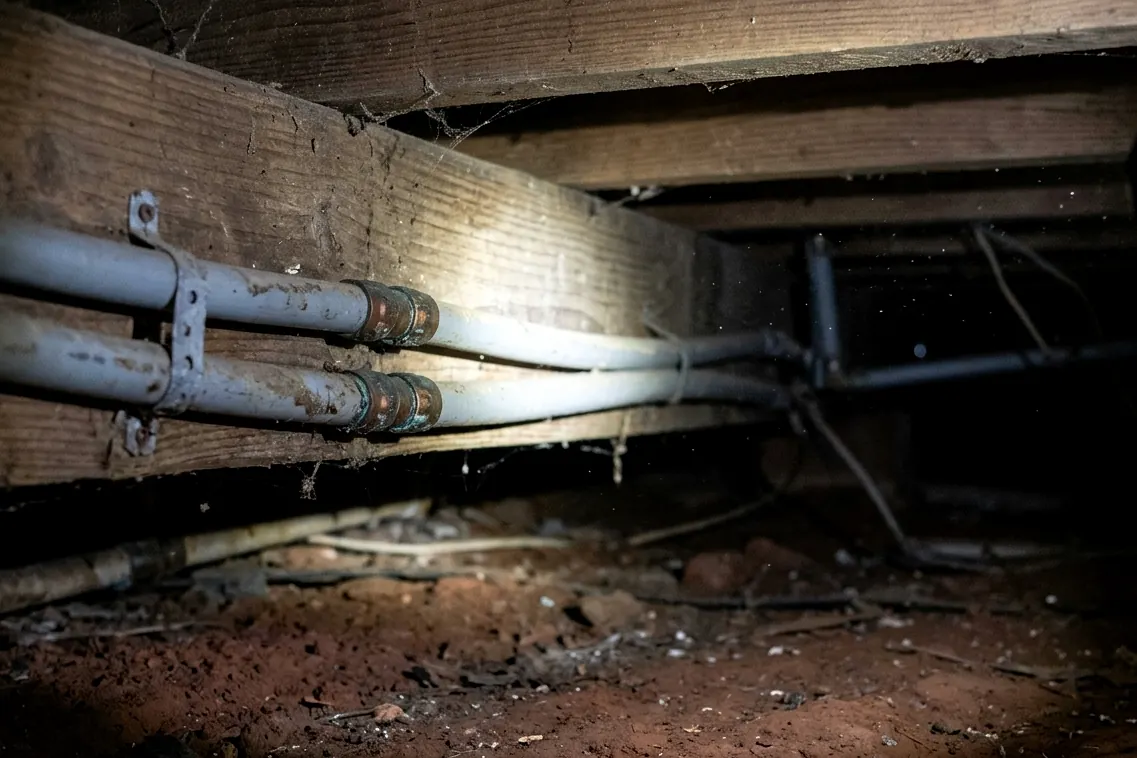
Gray, flexible pipe about half an inch to an inch across, often stamped PB2110, is the classic sign. Fittings are crimped with copper or aluminum bands, and older installs used gray or white plastic fittings. Do not confuse it with PEX, the newer flexible pipe that usually comes in red, blue or white and is printed with the letters PEX. CPVC is rigid and cream or tan in color.
- At the top of the water heater, where the hot and cold lines connect
- Under kitchen and bathroom sinks, behind the shut-off valves
- In the crawl space, running along the floor joists
- Where the main water line comes through the foundation or into the garage
- At the meter box, where a blue or gray service line may run toward the house
Sometimes only part of the house is PB
Many Raleigh-area homes are now a mix. A previous owner may have replaced the lines that leaked and left the rest. A water heater swap may have put new copper or PEX at the tank while gray pipe still runs through the crawl space. Seeing new pipe in one spot does not mean the whole house was done, so check more than one location before deciding what you have.
The underground service line deserves its own look. Some homes from this era used polybutylene, often blue, for the line from the meter to the house. A leak there may show up as a soggy patch in the yard, a higher water bill, or the meter moving with every faucet off. Replacing that line is water line replacement work rather than interior repiping.
Your options if you find it
Some owners replace PB as soon as they find it. Others wait. Neither is wrong, but waiting is a bet that the next failure will be small and caught early. Fittings are the usual weak point, so homes where earlier leaks were fixed with new fittings still have the original pipe aging between them, and the next weak fitting may be in a spot that is much harder to see.
If you replace it, you can do sections or the whole house. Polybutylene pipe replacement in a single accessible area, like a crawl space run, is the smaller job. Whole-house repiping replaces every supply line with PEX or copper, usually over a few days, with small openings in drywall that get patched afterward. Crawl space homes are often the easiest to repipe because most lines are reachable from below.
What it costs and what affects the price
For a typical Raleigh-area single-story home on a crawl space, a full repipe often runs about $4,870 to $9,640. Two-story homes, slab foundations and finished basements cost more because more lines run through finished walls. Partial replacements cost less up front but add up if you do them one leak at a time. The real price comes after a plumber walks the house and sees where the lines run and how they are reached.
- Number of bathrooms, fixtures and appliances on the system
- Crawl space, slab or basement foundation
- How much drywall has to be opened and patched
- Whether the underground service line is also PB
Selling or buying a house with PB
Home inspectors in the Triangle know what polybutylene looks like, and many will call it out in their report. Buyers may ask for a repair credit or for replacement before closing, and some homeowners insurance companies ask about it when writing a policy. If you plan to sell in the next few years, it is usually smoother to deal with it on your own schedule than in the middle of a deal with a closing date set.
If you are not sure whether what you are looking at is PB, take a clear photo of the pipe and any printing on it. Serenity Plumbing works across Raleigh and Cary, and you can call (919) 557-9058 day or night to talk through what you found. A plumber can usually tell from a quick look whether it is PB, PEX or CPVC, and whether the service line is part of the problem.
Follow-up questions
Can a leaking polybutylene fitting just be repaired?
Yes. A leak at a PB fitting can be repaired with a transition fitting to PEX or copper, and that stops the leak in front of you. It does not change the age of the pipe on either side, though. Spot repairs make sense as a short-term fix, but they are not a long-term answer for a whole system of original PB.
Is gray pipe in a crawl space always polybutylene?
Not always. Some gray pipe is PVC used for drains or condensate lines, which is rigid and much larger. PB supply pipe is flexible, usually under an inch across, and often stamped PB2110. If the gray pipe bends easily and connects to faucets, toilets or the water heater, it is very likely polybutylene and worth a closer look.