Mostly because of age and trees. Older Raleigh homes often have clay or cast iron sewer laterals with joints that loosen over decades, and the large hardwoods in these neighborhoods send roots into every gap they can find.
What the pipe under an older yard is made of
The sewer lateral is the pipe that carries everything from your house to the city main, usually under the front yard. In older neighborhoods like Oakwood, Five Points, Hayes Barton and Mordecai, that line is often vitrified clay laid in short sections with joints every few feet. Homes from the middle of the last century may have cast iron inside the house and clay or cast iron outside. Some laterals have been replaced with PVC over the years, but many have not.
Clay itself holds up well. The joints are the weak point. Early joints were packed with mortar or other materials that crack and wash out over time, leaving small gaps. Cast iron lasts a long time too, but it rusts from the inside, and the scale that builds up narrows the pipe and gives waste something rough to catch on. Either way, an older lateral has more places for trouble to start than a newer smooth plastic line does.
Tree roots and red clay soil
Raleigh's older neighborhoods are known for their big oaks, maples and willow oaks, and those trees are a large part of the problem. Roots go looking for water, and a sewer lateral leaks a little moisture and warmth at every loose joint. A hair-thin root gets in, feeds on what flows by and grows into a mat that catches paper and grease. Over time it can fill most of the pipe.
The Triangle's red clay soil adds its own stress. It holds water after heavy summer storms and shrinks during dry spells, so the ground around a pipe moves over the years. That movement can shift clay sections out of line, creating offset joints or low spots called bellies where waste settles. A line that started with proper slope can end up with sections that barely drain at all.
Warning signs before a full backup
Sewer lines rarely fail without hints. The early signs are easy to blame on a single fixture, but when they show up in more than one place at once, the problem is usually further down the line. A slow drain in one sink is a local clog. Several drains acting up together points to the main line, and that is the moment to act before sewage comes up through a floor drain or tub.
Recurring backups are a strong sign of roots or a structural defect. Clearing the line restores flow for a while, but if the same problem returns every year or two, something in the pipe is catching debris again, and it is worth finding out what before the next one. Keep a note of the dates of past backups and clearings. That pattern, along with the age of the house, helps a plumber judge whether roots, a sag or a broken section is the likely cause.
- Gurgling from a toilet when a nearby sink or tub drains
- Water rising in the tub or shower when the washing machine empties
- Several drains slowing down at the same time
- A sewer odor in the yard or near the cleanout
- An unusually green or soggy patch over the line in dry weather
Who owns which part of the line
This catches many people by surprise. In Raleigh, as in most cities, the homeowner is generally responsible for the private lateral from the house to the connection at the public sewer, while the City of Raleigh maintains the main and its own part of the connection. Exactly where that line falls depends on the property and the utility's rules. Cary, Durham and other Triangle utilities follow a similar split with their own details.
If your house has a cleanout near the property line, that often marks the practical boundary. If the backup is in the city main, neighbors on the same street may notice it too, and the utility should be called. If only your house is affected, the problem is usually in your lateral. A cleanout makes it much easier to tell, which is why some owners add one when they do not have it.

How the problem gets found and fixed
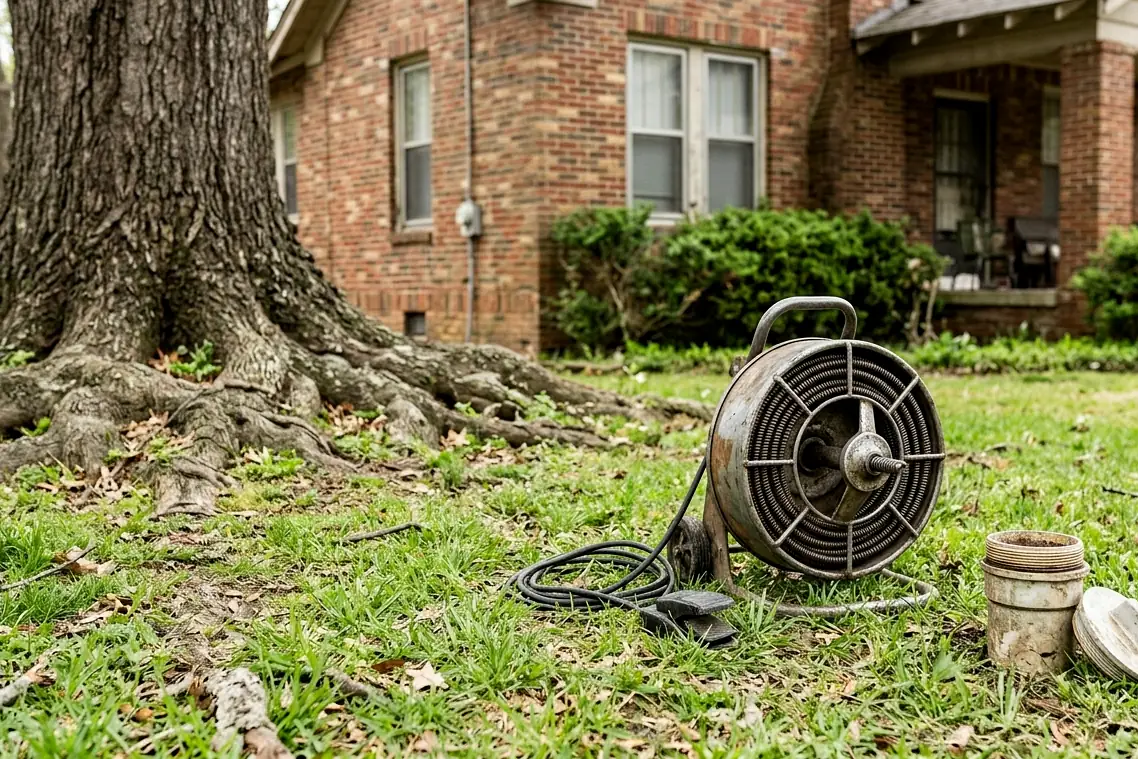
The first step is usually clearing the main line with a cable machine to restore flow. That fixes the immediate backup. The second step is a sewer camera inspection, which shows what caused it: roots at a joint, an offset section, a belly, broken pipe or heavy scale in cast iron. The video tells you whether you are looking at routine maintenance or a repair.
From there the options depend on what the camera shows. A short broken section can be dug up and replaced. Longer runs of failing clay often make sense for trenchless sewer repair, which lines or replaces the pipe with small access pits instead of trenching the whole yard and every tree root in the way. That matters in older neighborhoods with mature trees, brick walks and established landscaping over the line. Not every pipe is a candidate, though, and a badly collapsed or sagging section may still need to be dug.
- Cabling or hydro jetting to clear roots and buildup
- Spot repair of one broken or offset section
- Trenchless lining or pipe bursting for a long failing run
- Full excavation and replacement when the line has collapsed
What it typically costs
Clearing a main line clog in the Raleigh area usually runs about $187 to $428, and a camera inspection often adds $167 to $389 when done on its own. Spot repairs to a lateral commonly fall between $1,870 and $4,460, depending on depth, location and what has to be dug up. Full replacement or trenchless work on a long run costs more. The real number comes after a plumber has seen the line on camera.
If drains are backing up right now, stop running water in the house and give us a call at (919) 557-9058. Serenity Plumbing answers day or night and works throughout Raleigh's older neighborhoods. Clearing the line comes first, and the camera can follow so you know what you are dealing with before deciding on anything bigger. You can watch the video with the plumber, see the problem spots and their depth, and decide on a fix with the full picture in front of you rather than guessing.
Follow-up questions
Will cutting down a tree stop roots in the sewer line?
Not right away. Roots already inside the pipe will die back, but they stay in the line until they are cleared, and the joints they entered are still open. Nearby trees can send new roots to the same gaps. Clearing the line and fixing the damaged joints addresses the cause more reliably than removing a tree.
How often should an older sewer lateral be cleared?
There is no fixed schedule. Some clay lines with root intrusion need clearing every one to two years to stay ahead of backups, while others go much longer. A camera inspection after a clearing shows how quickly roots are likely to return and whether a repair would cost less over time than repeated visits.