It depends on fuel, household size and budget. A gas tankless unit suits a busy household that plans to stay put, while a standard tank is often the better value for all-electric homes, small households and tighter budgets.
How each type makes hot water
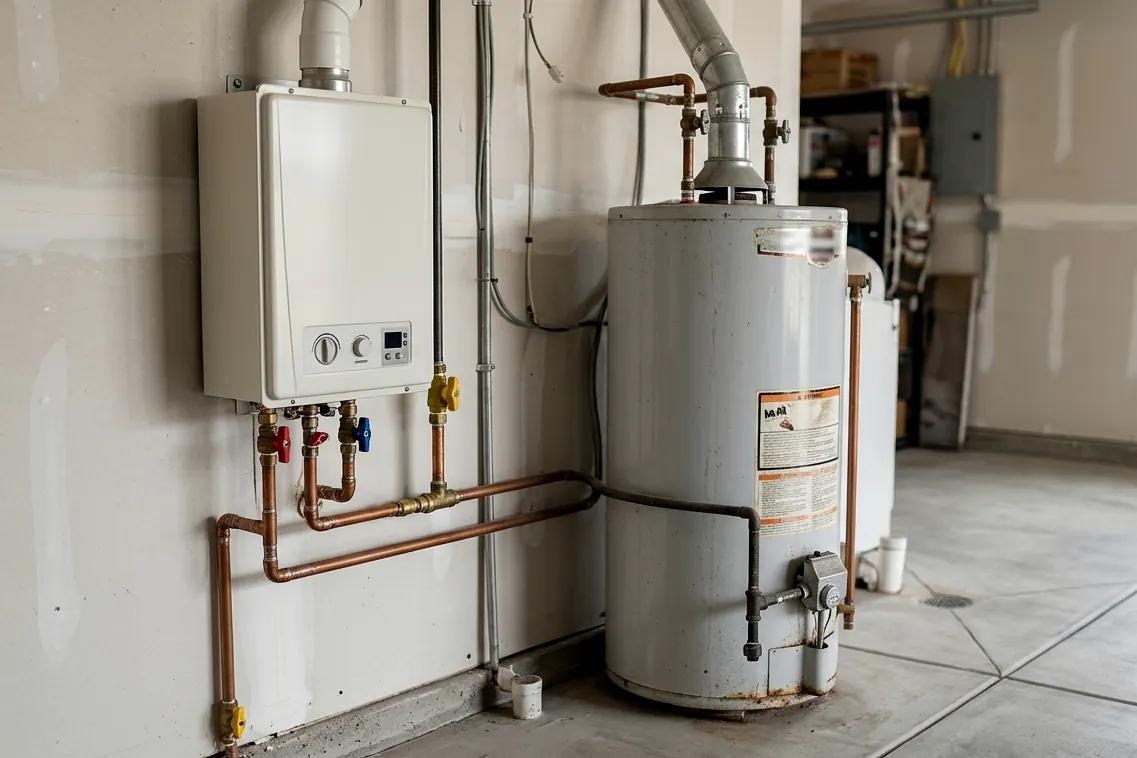
A tank water heater keeps 40 to 80 gallons hot all the time and refills as you use it. When the tank runs low, you wait for it to recover. A tankless unit heats water only as it flows through, so it does not run out, but it can only heat so many gallons per minute at once. The difference shows up most when two showers, the dishwasher and the washing machine all want hot water at the same moment.
Both types last longer with care. A typical tank lasts about 8 to 12 years in the Triangle, while a tankless unit that gets regular descaling can run 15 to 20 years. That longer life is one of the main reasons tankless makes sense for some owners, because it offsets part of the higher price at the start and pushes the next replacement much further out.
Fuel matters more than anything else
In much of the Triangle, the deciding factor is whether the house has natural gas. A gas tankless heater is the usual choice for owners who want endless hot water, and it works well in homes that already have a gas line to a furnace or range. Running a new gas line is possible, but it adds to the cost, so the math changes when gas is not already at the house.
Many Raleigh-area homes, especially those built with heat pumps, are all-electric. Electric tankless units need a lot of electrical capacity, often more than an older panel can spare, and they struggle to keep up in winter when incoming water is colder. For these homes a standard electric tank or a heat pump water heater is often more practical. A heat pump unit uses much less electricity but needs space and air around it, so a garage works best.
Sizing for Raleigh water temperatures
Tankless units are sized by how much they can raise the water temperature at a given flow. In the Raleigh area, incoming city water is noticeably cooler in January than in August, so a unit that easily handles two showers in summer may fall short in a cold snap. A good installer sizes for winter conditions, not average ones, and checks the gas supply before settling on a model.
Getting the sizing wrong is the main reason people end up unhappy with tankless. A slightly larger unit, or two units in a big house, avoids the lukewarm shower that shows up on the first cold morning of the year. If you are replacing a tank, the plumber will look at your usage, the gas meter and the vent path before recommending a size, which is part of why the quote takes a site visit.
- Count the fixtures you run at the same time, not the total in the house
- Plan on about 2 gallons per minute for each shower, more with high-flow heads
- Size for winter water temperatures, which run much colder
- Check the gas line size, since many existing lines are too small for a large unit
Cost over time
Up front, a standard tank is the less expensive install. In the Raleigh area, replacing a tank typically runs about $1,487 to $2,940, while a gas tankless water heater installation usually falls between $3,860 and $6,470, depending on venting, gas line work and location. Converting from a tank to tankless costs more than swapping one tankless unit for another because of the new venting and gas work involved.
Tankless units save energy because they do not keep a tank hot all day, but the savings vary by household. A family of five that uses a lot of hot water sees more benefit than a couple who travel often. Most owners choose tankless for the endless hot water and the longer life rather than for the energy bill alone, so it helps to be honest about which of those matters most to you.
Maintenance in Triangle homes
Both types need some attention. A tank benefits from an occasional flush to clear sediment, and the anode rod that protects the steel wears out over time. A tankless unit needs its heat exchanger descaled on a regular schedule, usually once a year, plus a clean inlet filter. City water in Raleigh is not especially hard, but well water in rural parts of Johnston and Franklin counties can be, which shortens that interval.
- Tank: flush yearly and have the anode rod checked every few years
- Tankless: descale the heat exchanger and clean the inlet filter
- Both: have the relief valve tested and watch for leaks at connections
When to pick which
A tank is usually the right call when the house is all-electric, the budget is tight, or you may move within a few years. Tankless makes the most sense in a gas home with a busy household where you plan to stay long enough for the longer life and energy savings to matter. Owners with a long run from the heater to the main bath sometimes add a hot water recirculation pump with either type to cut the wait at the tap.
If you want help deciding, Serenity Plumbing works in Apex and across the Triangle. Call (919) 557-9058 and a plumber can talk through your fuel, usage and space, then look at the setup in person before giving a price. We answer 24/7, so if your old tank has already failed, the decision can be made quickly and hot water is often back the same day.
Follow-up questions
Can a tankless water heater go in an attic?
Sometimes. Gas units need a proper vent path and combustion air, and the location has to allow service access and a drain for condensate on high-efficiency models. Garages and exterior walls are more common spots in the Triangle. An attic install is possible when the space, venting, drainage and freeze protection all work for that house.
Do tankless units work during a power outage?
Gas tankless units still need electricity for their controls and fan, so most stop working when the power goes out. A gas tank heater with a standing pilot can keep making hot water during an outage, which matters to some owners during summer storms and hurricane remnants. Electric water heaters of either type stop until power returns.