Once a year. The City of Raleigh requires backflow prevention assemblies on irrigation systems and certain other connections to be tested annually, and again after installation, repair or relocation. Other Triangle utilities run similar programs with their own details.
What a backflow assembly does
Your water service is supposed to flow one way: from the main in the street into the house. Backflow is when water reverses direction, either because pressure in the main drops, as with a water main break or heavy hydrant use nearby, or because pressure on your side rises above the supply. When that happens, whatever sits in your irrigation lines, boiler or fire sprinkler piping can be pulled back toward the public supply. Irrigation is a real concern because sprinkler heads sit in soil treated with fertilizer and pesticides.
A backflow prevention assembly is a set of check valves and relief parts that stops that reverse flow. Unlike a simple check valve, it has test cocks so a trained tester can attach a gauge and confirm each part is holding. That is why utilities require testing: the device can look fine from outside while a spring or rubber seat inside has quietly stopped sealing.
The annual testing rule in Raleigh
The City of Raleigh runs a cross-connection control program through its public utilities department. If your property has a testable backflow assembly, most often on a lawn irrigation system, the city expects it to be tested every year. The utility keeps records by address and typically sends a notice when a test comes due. Homes with a separate irrigation meter almost always have one of these assemblies, and many newer subdivisions in Raleigh were built with irrigation from the start.
Testing is not a one-time event at installation. A new assembly is tested when it goes in, then every year, then again any time it is repaired, rebuilt or moved. If the test fails, the device has to be repaired or replaced and tested again before it is back in compliance. Missed tests lead to follow-up notices, and if they are ignored long enough, the utility can take steps that affect water service to that connection.
Common assembly types you may have
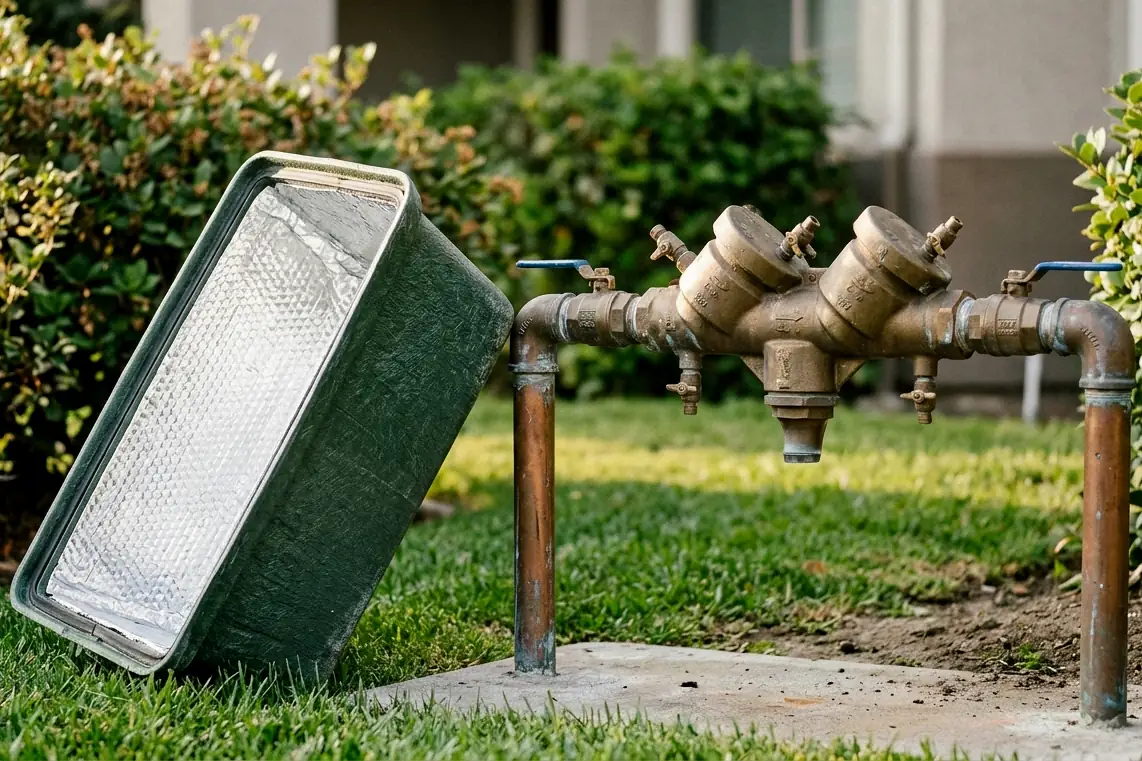
Most residential backflow devices in the Triangle are one of a few types. You can usually tell which one you have by where it sits and what it looks like, and the type affects how it is tested, how it is repaired and how well it handles cold weather. If you are not sure, a photo of the device and its location is enough for a plumber to identify it.
An RPZ may spit a small amount of water from its relief port when pressure swings, which is normal. Steady dripping or a constant stream is not, and it usually means a check valve or the relief valve is not sealing. That is worth a call before the yearly test, because a running relief port wastes water around the clock and the device will fail its test anyway.
- Reduced pressure zone (RPZ) assembly: two checks with a relief port between them, mounted above ground
- Double check valve assembly: two checks in a line, sometimes in a ground-level box near the meter
- Pressure vacuum breaker (PVB): a single check with an air inlet, mounted above the highest sprinkler head
- Fire sprinkler assemblies on larger homes and commercial buildings, tested on the same yearly cycle
Who can test it and what it costs
Backflow tests have to be done by a tester who is registered with the utility's program and uses a calibrated test kit. The tester checks each valve, records the readings and reports the results to the utility. Serenity handles annual backflow testing for homes and businesses, and the results go to the utility directly, so you do not have to send paperwork yourself or remember which office wants it.
For a typical residential irrigation assembly, a test usually runs about $87 to $164. If it fails, a rebuild with new rubber parts and springs often falls between $187 and $463, while a full backflow preventer replacement costs more, especially for larger RPZ units. Those are typical ranges; the real price comes after the plumber looks at the device, its size and its condition.
Freeze protection between tests
Backflow assemblies on irrigation lines sit outdoors, and the Triangle gets enough hard freezes to crack a brass body or blow out a check. A cracked assembly does not just fail its next test, it leaks. Many irrigation owners shut off and drain the system for winter, then turn it back on in spring, which is also a convenient moment to schedule the annual test so both jobs happen together.
- Close the irrigation shut-off valve before the first hard freeze
- Drain the assembly, or have it drained, so no water sits in the bodies
- Use an insulated cover or heated enclosure if the system stays on all year
- Watch for leaks or a running relief port when the water goes back on
Outside Raleigh city water
If your water comes from the Town of Cary, Durham, OWASA in Chapel Hill and Carrboro, or Johnston County utilities, the same idea applies but the details differ. Each utility sets its own notice process, tester list and reporting method. Homes on private wells in rural parts of the Triangle are generally outside these programs, although a backflow device can still make sense to protect the well. When a notice arrives and you are not sure what it is asking for, give us a call at (919) 557-9058.
It also helps to keep a simple record. Note the device type, its size and where it sits, along with the date of each test and any repair. When you sell the house, a buyer or their inspector may ask about the irrigation system, and a clean testing history answers that question quickly. It also tells the next tester what to expect before they arrive.
Follow-up questions
Can a backflow test be done in the winter?
Yes, as long as the assembly is pressurized and not frozen. On irrigation systems that are shut off for winter, many owners schedule the test in spring when the water goes back on. If your due date falls in a cold month, a tester can usually work on a mild day, and the utility only needs the result by the deadline.
Does the water stay on during a backflow test?
The water to the protected line, usually the irrigation system, is shut off for a short time while the tester checks each valve. House water usually stays on unless the assembly protects the whole service. Most residential tests take well under an hour, and a small amount of water is released from the test cocks during the readings.